The Simple Way to Build a One-Person Online Business With AI
Artificial intelligence is changing the way people can build small online businesses. What once required graphic design skills, technical knowledge, expensive software, inventory, and a large amount of time can now be handled with a collection of AI-powered tools.
But there is an important difference between talking about AI business ideas and actually building one.
The most useful lesson from the approach discussed in the video is not simply, “Use AI to make money.” It is about creating a simple business system where AI helps with research, product creation, optimization, and repetitive tasks.
One example is an AI-assisted print-on-demand business selling products through Etsy. The model combines several simple ideas: find a specific customer need, create something that solves it, use AI to speed up production, automate fulfillment, and take advantage of an established marketplace for traffic.
Similar Glasp discussions around AI print-on-demand businesses reinforce the same basic pattern, especially the importance of choosing a focused niche, validating demand, and using automation to reduce repetitive work. (Glasp)
Start With a Problem, Not Just an AI Tool
One of the biggest mistakes beginners can make is starting with the technology.
They discover a new AI image generator and immediately start creating hundreds of pictures. Or they find an AI writing tool and begin producing content without knowing who will actually want it.
A better starting point is the customer.
Ask:
What does this audience want?
What problem are they having?
What product or service would make their life easier, more enjoyable, or more interesting?
This approach was illustrated by a simple example involving dog-themed clothing.
The creator noticed that Etsy had plenty of general dog merchandise, but there were fewer clever products specifically aimed at individual breeds. That suggested a potential gap in the market.
A market gap exists when people are interested in something, but there are not enough good products, services, or content available to satisfy that interest.
That can be a powerful opportunity for a small business.
The idea does not have to be revolutionary. Sometimes the opportunity is simply making something more specific, more useful, more entertaining, or better suited to a particular audience.
For example, instead of creating generic products for “dog lovers,” you might create products for owners of specific breeds.
Instead of creating generic business content, you might create resources specifically for first-time entrepreneurs over 50.
Instead of making general fitness products, you might focus on a particular group with a specific goal.
The more clearly you understand the customer, the easier it becomes to create something they may actually want.
Your Personal Experience Can Be an Advantage
Another useful idea is what the creator calls an “unfair advantage.”
This does not mean cheating or having some secret connection.
It simply means choosing an area where you already have knowledge, interest, experience, or familiarity with the customer.
If you are already part of the audience, you have a built-in advantage.
You understand the language.
You know what annoys you.
You know what products you would buy.
You understand what looks good and what does not.
This becomes particularly important when AI gives you dozens of possible ideas.
Imagine asking an AI image generator to create 50 designs.
Which one should you sell?
The AI can produce the options, but it cannot automatically know which one will appeal most to your particular audience.
Your human judgment still matters.
You can look at the designs and ask yourself, “Would I actually buy this?”
That combination of AI speed and human judgment is much more useful than simply letting AI make every decision.
Look for Gaps Instead of Copying Competitors
It can be tempting to look at successful Etsy stores, Amazon products, or social media accounts and copy what already works.
The problem is that established sellers often have something you do not have yet, such as reviews, followers, brand recognition, and customer trust.
If your product is almost identical, why would someone choose yours?
Finding a gap gives customers a reason to notice you.
The gap could be:
A product that does not exist yet.
A product designed for a smaller niche.
A different style or approach.
A service that solves a specific problem.
Content covering a topic that is underserved.
A product variation that customers have been asking for.
AI can help you find these opportunities.
Instead of asking an AI chatbot, “Give me 100 business ideas,” ask it to research a specific audience and identify recurring complaints, unanswered questions, frustrations, and requests.
That changes the process from guessing to researching.
Build an AI Workflow
Once you have an idea, the next step is creating a workflow.
Think of a workflow as a series of steps that take you from an idea to a finished product.
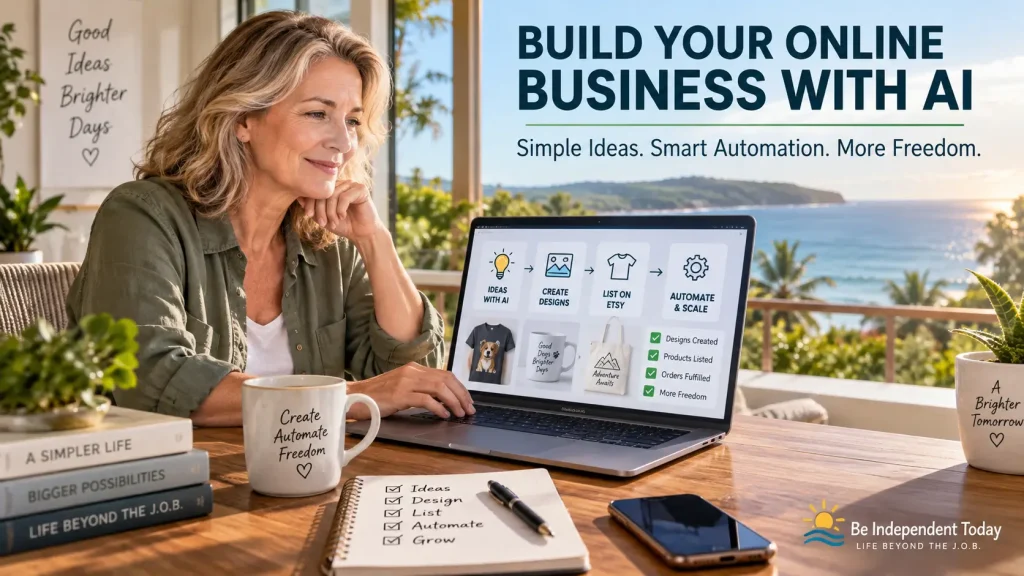
For an AI-assisted print-on-demand business, a workflow might look something like this:
- Research the niche.
- Brainstorm product ideas.
- Create the artwork.
- Edit and prepare the design.
- Upload the design to a print-on-demand provider.
- Create the product listing.
- Optimize the title, description, and tags.
- Publish the product.
- Analyze the results.
- Improve the next product.
Different AI tools can handle different parts of this process.
An AI chatbot can help brainstorm ideas and write product descriptions.
An AI image generator can create artwork.
A graphic design platform can remove backgrounds, upscale images, and prepare files for printing.
A print-on-demand provider can handle production, packaging, and shipping.
The important point is that you do not need one AI tool to do everything.
You can build a system where each tool does the job it is best suited for.
Recent Glasp material on AI print-on-demand businesses similarly emphasizes dividing the process into specialized stages, from niche research and design to listing creation and fulfillment. (Glasp)
Print on Demand Removes a Major Barrier
Print on demand is particularly interesting because you do not have to purchase large quantities of inventory before knowing whether people will buy.
Instead, you create a design and apply it to products such as T-shirts, mugs, sweatshirts, stationery, or other merchandise.
When a customer places an order, the print-on-demand company produces the item, packages it, and ships it.
That means the business owner can focus on creating products and attracting customers instead of maintaining a warehouse.
This is one reason print on demand works well with AI.
AI can dramatically speed up the creative side while the print-on-demand provider handles much of the physical work.
The result can be a relatively lightweight business model for a solo entrepreneur.
Of course, lightweight does not mean effortless. There are still platform fees, production costs, customer service, taxes, competition, product quality issues, and intellectual-property considerations to manage.
AI makes parts of the process faster, but it does not eliminate the need to run a real business.
AI Can Help Prepare Designs
The design process can also be broken into simple stages.
First, use an AI chatbot to brainstorm ideas.
Next, use an AI image generator to create artwork.
Then move the artwork into a graphic design tool to prepare it for production.
For example, the workflow described in the video uses AI to generate designs, then uses Canva to remove backgrounds and upscale the artwork before exporting a transparent PNG suitable for printing.
That last part is important.
An image that looks good on a computer screen is not necessarily ready for a physical product.
Resolution, transparency, sizing, placement, and file format all matter.
AI can help with these tasks, but the final product still needs to be checked.
A good rule is simple: automate the repetitive work, but inspect the finished product.
AI Agents Take Automation a Step Further
There is an important difference between an AI chatbot and an AI agent.
A chatbot generally waits for instructions.
You ask it to do something, and it responds.
An AI agent can be given access to tools and instructed to complete a sequence of tasks.
For example, instead of manually creating 20 variations of a design, an agent could potentially be instructed to create the variations, open a design application, modify the files, export them, and organize the results.
This is where automation becomes especially interesting for people who already have jobs or other responsibilities.
The goal is not necessarily to remove yourself completely from the business.
The goal is to spend your time on the parts that require judgment while letting software handle repetitive processes.
Think of it as moving from doing every task manually to managing a system.
That distinction is becoming increasingly important in the one-person business model. Recent Glasp analysis describes this shift as moving toward “orchestration,” where a solo operator coordinates AI tools, platforms, and automated workflows rather than personally performing every task. (Glasp)
Creating Multiple Product Variations
One of the most interesting uses of automation is creating variations.
Imagine you have a design that works well for one type of customer.
Instead of manually rebuilding it dozens of times, an AI workflow could potentially adapt the concept for different audiences.
The example in the video involved taking a design concept and creating variations for different cat colors.
Rather than creating each variation manually, an AI agent was instructed to generate multiple versions, adjust the design, use Canva to prepare the files, and export them using consistent settings.
The process still took time, but it required far less hands-on work.
This illustrates an important principle:
Automation becomes more valuable when a task is repetitive.
If something needs to be done once, automation may not be worth the effort.
If something needs to be done 20, 50, or 500 times, automation can become extremely useful.
Getting Traffic Without Building Everything From Scratch
Creating products is only half the business.
People need to find them.
One strategy described in the video is to use an established marketplace such as Etsy rather than trying to build an audience from zero.
This is an important concept for beginners.
You do not always have to create your own website, audience, and traffic source before you can begin selling.
You can potentially go where your customers already are.
For different business models, that might mean Etsy, Amazon, YouTube, Pinterest, TikTok, LinkedIn, or another platform.
The key is matching the platform to the customer.
Etsy is already a shopping destination.
YouTube is already a video destination.
Pinterest is already a visual discovery platform.
Amazon is already a shopping destination.
Using an established platform can reduce the amount of infrastructure you need to create yourself.
Understanding Platform Algorithms
There is another important lesson here.
Getting listed on a marketplace does not guarantee that customers will see your product.
Platforms use recommendation and search systems to decide which products or content to display.
That means your listing needs to clearly communicate what it is and who it is for.
Titles, descriptions, tags, images, keywords, and customer engagement can all influence how a marketplace understands your product.
AI can help organize and improve this information.
For example, you could provide an AI chatbot with your product image and ask it to suggest a product title, description, and relevant search terms based on the intended audience.
However, AI-generated SEO should not simply mean stuffing a listing with random keywords.
The words need to accurately describe the product.
Research is still important.
Glasp research on Etsy listings also highlights keyword research and demand validation as important steps before creating and publishing products. (Glasp)
Do Not Confuse Automation With Guaranteed Income
There is one important reality to keep in mind.
Automation does not guarantee sales.
AI can make creating products faster.
It can make research easier.
It can automate repetitive tasks.
It can help write listings.
It can help produce variations.
But none of these things automatically creates demand.
That is why the first step remains the most important one: understand the customer.
A business built around something nobody wants can be automated perfectly and still make no money.
The goal is not to create more products simply because AI makes it possible.
The goal is to create better products for a clearly defined audience.
Quality, relevance, customer demand, and testing still matter.
There are also important considerations around copyright, trademarks, platform rules, and AI-generated content. Glasp material on AI art businesses specifically highlights the importance of researching marketplace terms and intellectual-property rules before selling AI-generated products. (Glasp)
The Bigger Opportunity With AI
The real opportunity may not be “making money with AI” in isolation.
It may be using AI to make a small business easier to operate.
That is a much more practical way to think about it.
You can use AI to research.
You can use it to brainstorm.
You can use it to create.
You can use it to edit.
You can use it to write.
You can use it to organize.
You can use it to automate.
And you can use it to analyze what is working.
But the business still needs a human at the center.
Someone needs to understand the customer.
Someone needs to choose the opportunity.
Someone needs to decide what is worth creating.
Someone needs to judge quality.
Someone needs to monitor the results.
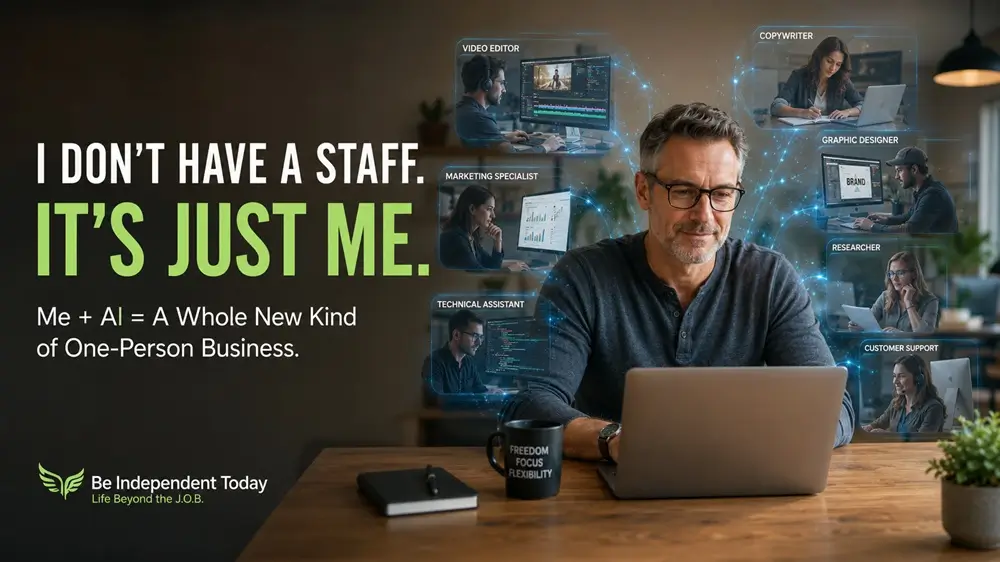
That is why a one-person AI business does not necessarily mean a business with no work.
It means one person can potentially accomplish much more by combining human judgment with increasingly capable technology.
A Simple Framework for Getting Started
If you want to explore this model yourself, keep it simple.
Start with an audience you understand.
Find a problem, frustration, interest, or underserved need.
Research whether other people have the same problem.
Create one simple solution.
Build a workflow around it.
Use AI to speed up repetitive tasks.
Use an established platform where your audience already spends time.
Test the product.
Study the results.
Improve what works.
Remove what does not.
Then automate more of the repetitive work as the business grows.
You do not need 1,000 products on day one.
You do not need a complicated website.
You do not need to become an expert programmer.
And you do not need to use every new AI tool that appears.
Start with one audience, one problem, one offer, and one simple workflow.
Then build from there.
The biggest lesson from this approach is simple: AI is not the business. AI is the leverage.
The business still comes from understanding people and giving them something they want.
AI simply gives a solo entrepreneur more ability to research, create, test, and improve without needing a large team.
For anyone looking to build an additional income stream around a busy schedule, that combination can make the idea of a one-person online business much more practical than it was just a few years ago.
Relevant Keywords: AI business, make money online with AI, AI side hustle, one person business, AI automation, AI agents, print on demand, Etsy print on demand, Etsy business, AI generated designs, passive income, residual income, online business, side income, AI workflow, digital marketing, niche research, market gaps, product research, Etsy SEO, AI tools, ChatGPT business, Canva AI, Printify, AI entrepreneurship, automated business, solo entrepreneur, Gen X entrepreneurship, online income, home business
Excerpt: Learn how AI can help build a simple one-person online business through niche research, product creation, automation, print on demand, and marketplace traffic.
Alternate Clickworthy SEO-Friendly Titles
- How to Build a One-Person Online Business With AI
- The Simple AI Side Hustle Anyone Can Start Online
- How AI Can Help You Build an Online Income Stream
- The 3-Step AI Business Model for Building Extra Income
- How to Use AI to Create Products and Sell Them Online
- AI Side Hustles: From Business Idea to Automated Income
- How to Start a Print-on-Demand Business With AI
- The Simple AI Workflow Behind a One-Person Online Business
- How to Turn AI Into Your Online Business Assistant
- Build an Online Business With AI Without Doing Everything Yourself
Learn more on Glasp: https://glasp.co/reader?url=https%3A%2F%2Fwww.youtube.com%2Fwatch%3Fv%3DP-ULbNbV5IQ